

Wave energy is based on a simple principle: movement in the ocean is converted into electricity. In practice, however, the path from prototype to offshore operation is both technically complex and financially demanding. Installation, maintenance and potential retrieval at sea involve costs of a completely different scale compared to laboratory development. For that reason, extensive land-based testing is a critical part of the development process.
Within INFINITY, dry testing and hybrid testing are being carried out on the Ocean Harvesting Technology’s PTO – the system that converts wave motion into electrical power.
– The key aspect is to gain confidence in each subsystem, says Giacomo Alessandri, Senior R&D Engineer at VGA S.r.l., who is responsible for planning and executing the testing campaign, as well as for the initial verification of key data.
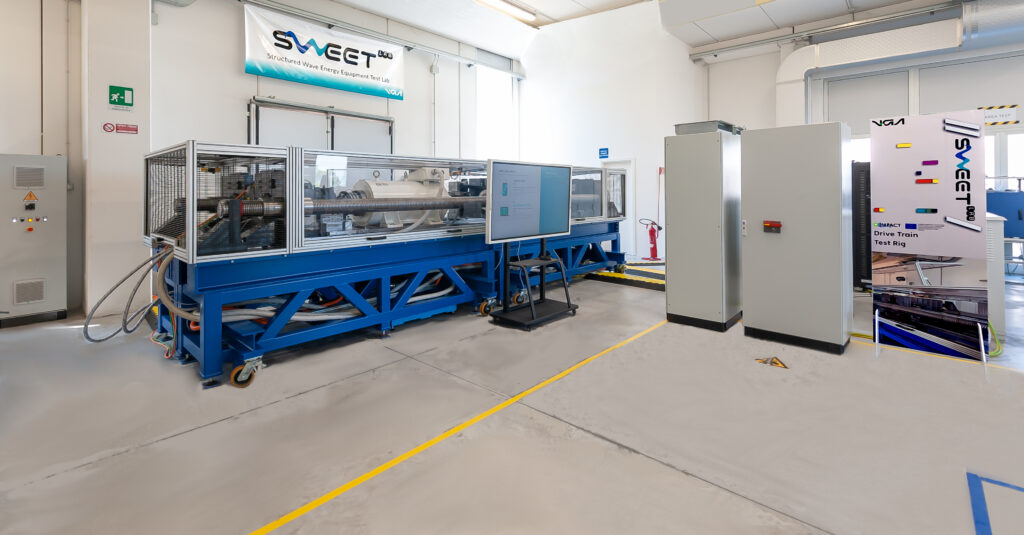
Tests carried out as part of the Horizon 2020 IMPACT project, shown here at one of the test facilities. (SWEET Lab).
Every subsystem must be carefully analysed and understood in detail. Performance, survivability, reliability and controllability are systematically characterised. The validation results are then used to calibrate simulation models, enabling developers to predict how the system will react under different conditions and during transitions between operating modes.
Verifying functionality before real forces take over
In emerging sectors such as wave energy, extensive operational data is often lacking. Components may be adapted from other industries, where they are used under different loading conditions. This makes it difficult to rely solely on existing reliability databases.
Through accelerated dry testing, it is possible to verify whether the failure modes identified during the design phase truly reflect the behaviour of the real subsystems. Particular attention is given to transitions between different states of the device, such as normal operation, maintenance, planned shutdown and emergency shutdown, ensuring that these procedures function as intended.
Skipping this step can have significant consequences.
– The costs of installations, operation, maintenance and removal of a prototype at sea have a different order of magnitude with respect to the ones associated with development at lab, says Giacomo Alessandri.
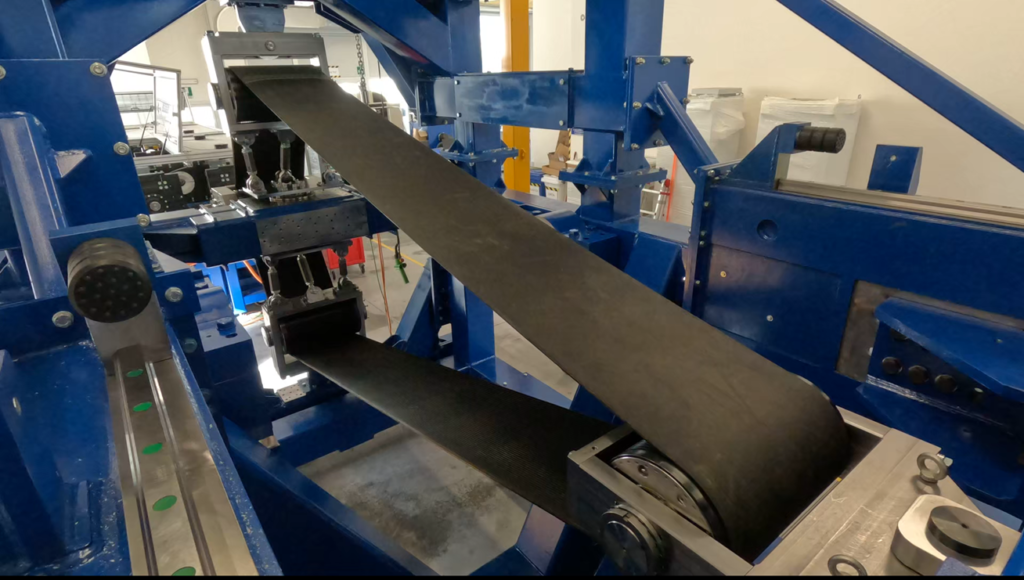
The difference in cost levels makes laboratory testing the final checkpoint before capital-intensive offshore activities begin.
Hybrid testing bridges models and reality
To further reduce uncertainty, hybrid testing is used, where real hardware components are connected to real-time simulations. Methods such as Hardware-in-the-Loop and Dual Hardware-in-the-Loop are applied to validate the agreement between simulation models and physical subsystems, or to align them in case discrepancies are found.
When multiple active subsystems – such as the power take-off and the control system – are tested together, the level of confidence in the overall device behaviour increases. Even passive systems can significantly influence the device response if not properly modelled.
– The INFINITY project can be considered as a case study of how advanced dry and hybrid testing can validate the main capabilities of a relevant-scale prototype of the PTO, considered as core of any Ocean Energy Converter, concludes Giacomo Alessandri.
By validating the technology at a relevant scale on land, both technical and financial risks are reduced before moving offshore. The same methodology can be applied to other ocean energy devices at early to mid Technology Readiness Levels, where structured validation is essential for further development.
Interested in learning more? Explore our Team section to connect with our researchers.