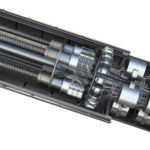
The Power-Take Off (PTO) hull of InfinityWEC has two overlapping cylindrical sections that move back and forth as the device captures energy from waves. Simulating bodies with changing geometry in CFD isn’t easy, but RISE researcher Claes Eskilsson has developed a new tool that makes the job simpler. The work will help the INFINITY team better understand how the wave energy converter behaves.
Claes has spent many years developing computer models for wave energy, so this was familiar territory. This time, he has been working with OpenFOAM, an open-source program used to simulate how water moves around different objects. The tricky part was getting the computer model to follow InfinityWEC’s changing shape without the calculations becoming unstable. Similar solutions already existed, but Claes has adapted the software so researchers can use the same kind of settings they’re already familiar with from other wave energy simulations with rigid bodies.
– I’ve worked with wave energy simulations for quite a few years, so this was right up my alley. We haven’t reinvented the wheel, but we’ve made it easier to do what we need for InfinityWEC, says Claes Eskilsson, researcher at RISE.
Built for InfinityWEC
The new tool uses a simplified model of the moving parts rather than trying to capture every detail of how the structure and water interact. Claes has also adapted the software specifically for InfinityWEC. Another part of his work has been connecting the device’s control system to the CFD simulation, so the two can work together.
Claes presented the work at RENEW 2026 in Lisbon in October. His presentation, “CFD simulations of wave energy devices with variable geometry: Application to the InfinityWEC”, was co-authored by Johannes Palm from Agaton Hydrodynamics.
Next stop: Maynooth
The model is almost ready for the next step. Researchers at Maynooth University will use it to run simulations, check how well their engineering models work and develop faster ways of predicting how InfinityWEC behaves.
– Now I just need to clean up the code to make it presentable and readable before handing it over to Maynooth. Then it’s their turn to put the model to work, says Claes.